Ageless Mind
-
Cognitive Reserve: How Seeking Novelty Keeps Your Brain Decades Younger
At DAYLONGLIFE, we often focus on physical movement and diet for long-term health, but keeping an Ageless Mind requires its own dedicated training ground.
Many people assume that doing the same daily crossword puzzle or playing a familiar memory game is enough to protect cognitive health. However, modern neuroscience reveals a surprising truth: once your brain becomes efficient at a task, it operates on autopilot—demanding very little metabolic energy or synaptic remodeling.
To build true cognitive reserve—the brain’s ability to improvise, find alternate neural pathways, and resist age-related decline—you must intentionally expose your mind to novelty, complexity, and active skill acquisition.
The Neuroscience of Cognitive Reserve & Neurogenesis
Your brain contains roughly 86 billion neurons connected by trillions of synapses. Throughout your entire lifespan, your brain retains the capacity for neuroplasticity—the ability to form new neural connections and physically reorganize itself in response to learning:
- Synaptogenesis Through Challenge: When you tackle a completely unfamiliar skill (like learning a new language, picking up an instrument, or navigating a new city without GPS), your brain is forced to sprout new dendrites and forge fresh synaptic connections.
- Building the Neural Buffer: Cognitive reserve acts like a mental savings account. Individuals with high cognitive reserve can experience physical changes in brain structure with age without exhibiting memory loss or functional decline, because their brains seamlessly reroute information around damaged pathways.
- Dopamine & Motivation Loops: Novel experiences trigger the release of dopamine from the substantia nigra and ventral tegmental area. Dopamine not only enhances mood and motivation, but also acts as a biological bookmark—signaling to the hippocampus that a new memory or skill is valuable enough to consolidate.
3 Science-Backed Ways to Challenge Your Brain Daily
To build cognitive reserve effectively, a task must meet two criteria: it must be novel (something you haven’t mastered) and mentally demanding (requiring focused concentration).
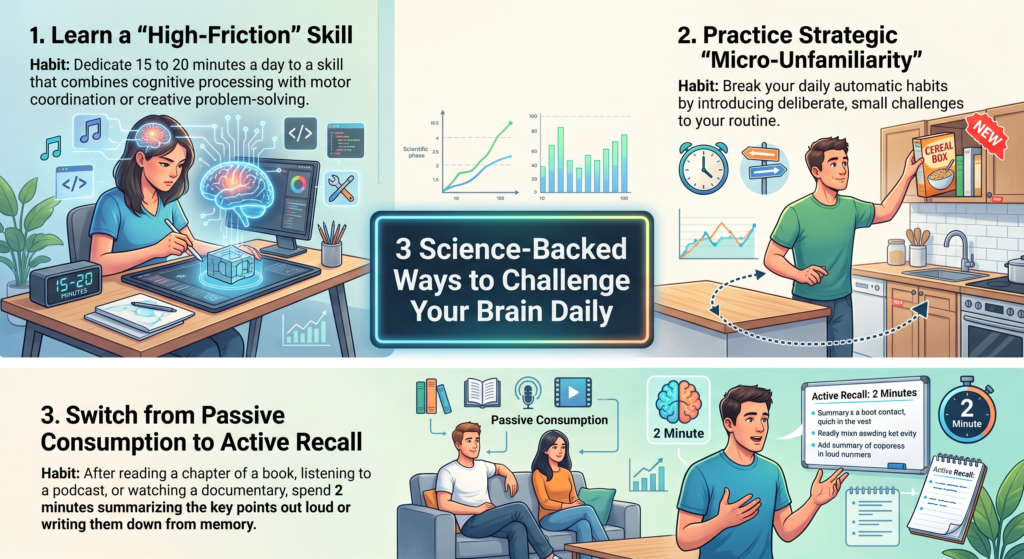
1. Learn a “High-Friction” Skill
- The Habit: Dedicate 15 to 20 minutes a day to a skill that combines cognitive processing with motor coordination or creative problem-solving.
- Examples: Playing the acoustic guitar or piano, learning conversational conversational phrases in a new language, taking up pottery, or learning chess opening strategies.
- Why it works: Complex skills engage multiple brain networks simultaneously—combining auditory, visual, motor, and executive functioning centers into a coordinated neural orchestra.
2. Practice Strategic “Micro-Unfamiliarity”
- The Habit: Break your daily automatic habits by introducing deliberate, small challenges to your routine.
- Examples: Brushing your teeth or eating with your non-dominant hand, taking a completely new walking route home without checking a map app, or learning to read music notation.
- Why it works: Forcing your brain out of automatic execution activates the prefrontal cortex, heightening alertness and stimulating spatial awareness.
3. Switch from Passive Consumption to Active Recall
- The Habit: After reading a chapter of a book, listening to a podcast, or watching a documentary, spend 2 minutes summarizing the key points out loud or writing them down from memory.
- Examples: Keeping a daily “learning journal” where you record three new facts or concepts you encountered during the day.
- Why it works: Passive consumption (scrolling videos or listening casually) builds very little cognitive reserve. Active retrieval forces your brain to reconstruct memory traces, strengthening neural wiring.
A Mind That Never Stops Growing
Brain aging is not an inevitable downhill slope—it is a malleable process heavily influenced by how you use your mind every day. By stepping out of comfortable mental routines and embracing the satisfying friction of learning something new, you ensure that your mind remains sharp, creative, and resilient for decades to come.
-
The Ageless Mind: How Daily Walking Keeps Your Brain Plastic, Focused, and Resilient
At DAYLONGLIFE, we often look for complex longevity hacks, but one of the most powerful tools for brain health is also the simplest: taking a walk.
Movement isn’t just physical exercise for your muscles and heart—it is direct nourishment for your nervous system. In modern neuroscience, rhythmic forward movement (like walking) is recognized as a primary stimulus for neuroplasticity, memory retention, and mental rejuvenation.
Stepping away from your desk or house for a daily walk is one of the most effective ways to shield your cognitive health, lower mental stress, and cultivate an ageless mind.
The Brain Science Behind the Stride
When you walk, complex neurological processes spark across your brain and body:

- BDNF Production (Brain “Fertilizer”): Walking stimulates the release of Brain-Derived Neurotrophic Factor (BDNF), a critical protein that supports the growth, survival, and repair of neurons—particularly in the hippocampus, the brain’s memory center.
- Optic Flow & Anxiety Reduction: Moving forward causes visual scenes to pass by your eyes—a biological process called optic flow. Research shows that optic flow naturally quietens the amygdala (the brain’s threat center), instantly lowering anxiety and systemic stress markers.
- Enhanced Cerebral Blood Flow: Walking increases cardiac output and arterial dilation, pumping fresh oxygen, glucose, and essential nutrients straight to your prefrontal cortex—the region responsible for focus, decision-making, and creative thinking.
3 Walking Styles for Cognitive Longevity
Not all walks serve the same purpose. Tailor your walk to what your mind needs most today:
1. The Morning “Circadian Anchor” Walk
- How to do it: Step outside within 1 hour of waking for a 15-to-20-minute walk without wearing sunglasses. Look toward the open sky as you move.
- Brain Benefit: Sunlight exposure combined with movement anchors your circadian clock, clears morning sleep inertia, and optimizes cortisol levels for steady daytime focus.
2. The “Mind-Wandering” Working Break
- How to do it: Leave your phone in your pocket (or at your desk) and take a 10-minute walk without listening to podcasts or music. Let your eyes scan the horizon and allow your thoughts to drift freely.
- Brain Benefit: Activates the brain’s Default Mode Network (DMN), allowing your subconscious mind to consolidate memories, process complex ideas, and generate creative breakthroughs.
3. The Post-Meal Metabolic Stroll
- How to do it: Take a gentle 10-to-15-minute walk right after lunch or dinner.
- Brain Benefit: Light movement after eating assists glucose uptake into muscle tissue, flattening post-meal blood sugar spikes. Preventing sharp glucose spikes protects brain capillaries and wards off afternoon brain fog.
Make It a Ritual, Not a Chore
You don’t need a grueling workout to keep your brain sharp. A brisk, intentional 15-minute walk taken once or twice a day accumulates into thousands of extra steps of cerebral blood flow every week.
Next time you feel stuck on a problem, tired from screen time, or mentally overwhelmed, don’t try to force your focus sitting down. Put on your shoes, step outside, and let your stride clear your mind.
-
The Ageless Mind: 5 Antioxidant-Rich Fruits That Protect Memory and Brain Power
At DAYLONGLIFE, we view the kitchen as the ultimate sanctuary for long-term health. When The Longevity Kitchen aligns with the Ageless Mind, every meal becomes an opportunity to nourish your nervous system and shield your cognitive vitality.
Your brain is constantly working, consuming around 20% of your body’s daily oxygen and energy. This intense metabolic activity leaves neural tissue particularly susceptible to oxidative stress—a biological imbalance where free radicals damage delicate brain cell membranes, slow down neural communication, and contribute to cognitive decline.
Nature’s sweetest defense against this process comes in the form of antioxidant-dense fruits. Packed with colorful polyphenols, flavonoids, and essential vitamins, these vibrant fruits cross the blood-brain barrier to calm neuroinflammation, support neuroplasticity, and keep your memory sharp.
5 Superior Brain-Boosting Fruits for Cognitive Longevity
Including a variety of deeply pigmented whole fruits in your daily routine provides a steady stream of protective compounds for your brain cells.
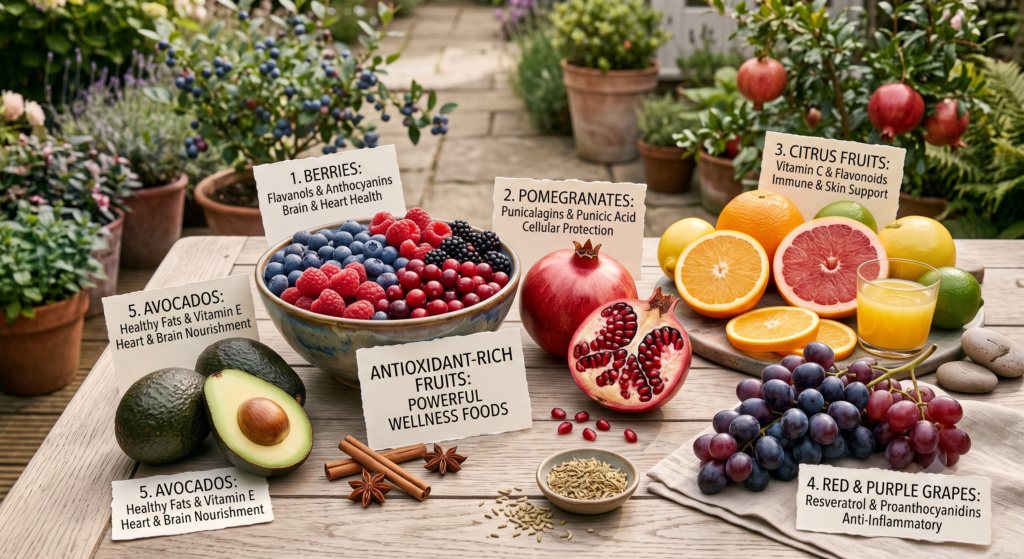
1. Wild Blueberries & Blackberries (The Flavonoid Powerhouses)
Dark berries are consistently celebrated as top-tier brain foods in longevity science.
- The Science: Deep blue and purple berries are rich in anthocyanins, potent flavonoid antioxidants that cross the blood-brain barrier.
- Cognitive Benefit: Anthocyanins accumulate in brain regions responsible for learning and memory (such as the hippocampus). They stimulate brain cell communication, enhance short-term memory recall, and protect against age-related neurodegeneration.
- How to Enjoy: Add a half-cup of fresh or frozen wild blueberries to warm morning oatmeal or enjoy them as a refreshing midday snack.
2. Pomegranates (Cellular Energy & Urolithin A)
Pomegranates have been revered across ancient Mediterranean and Asian cultures for centuries as symbols of life and longevity.
- The Science: Pomegranates are loaded with punicalagins and ellagitannins—unique polyphenols that gut bacteria convert into a compound called Urolithin A.
- Cognitive Benefit: Urolithin A triggers mitophagy, the natural cellular cleanup process that clears damaged mitochondria from brain cells, restoring cellular energy production and fighting mental fatigue.
- How to Enjoy: Sprinkle fresh ruby-red pomegranate seeds over leafy green salads or enjoy a small glass of pure, unsweetened pomegranate juice.
3. Oranges & Citrus Fruits (Hesperidin & Vitamin C)
Bright citrus fruits offer far more than simple immunity support—they are vital for cerebrovascular health.
- The Science: Oranges, lemons, and grapefruits contain high concentrations of Vitamin C along with a powerful citrus bioflavonoid called hesperidin.
- Cognitive Benefit: Hesperidin improves cerebral blood flow, delivering oxygen and glucose efficiently to brain tissue. Vitamin C acts as a primary antioxidant in the brain, neutralizing free radicals before they damage neural membranes.
- How to Enjoy: Eat whole organic oranges to retain their beneficial prebiotic fiber, or grate fresh organic orange zest over cooked grains and salads to capture concentrated citrus essential oils.
4. Red & Purple Grapes (Resveratrol Shield)
The deep skins of dark grapes hold one of the most thoroughly researched longevity molecules in modern science.
- The Science: Purple and red grape skins are abundant in resveratrol, a natural polyphenol that activates sirtuins (genes linked to cellular repair and longevity).
- Cognitive Benefit: Resveratrol promotes healthy circulation in the brain, supports synaptic plasticity, and shields neural connections from oxidative stress and inflammatory damage.
- How to Enjoy: Keep a bowl of chilled organic Concord or red grapes on your kitchen counter for a clean, sweet afternoon treat.
5. Avocados (Monounsaturated Fats & Lutein)
While often treated as a vegetable in cooking, the avocado is botanically a fruit—and a singular power food for the mind.
- The Science: Avocados combine healthy monounsaturated fatty acids with lutein, a fat-soluble carotenoid antioxidant that accumulates in brain tissue.
- Cognitive Benefit: The monounsaturated fats lower blood pressure and ensure smooth blood flow to the brain, while lutein enhances processing speed, working memory, and spatial focus.
- How to Enjoy: Slice fresh avocado over warm whole-grain toast, mash it into light dressings with lemon juice and olive oil, or pair it with sliced tomatoes and sea salt.
3 Simple Rules for Maximizing Fruit Antioxidants
- Eat the Whole Fruit: Always prefer whole fruits over filtered commercial juices. The natural fiber slows sugar absorption, preventing insulin spikes that cause brain fog.
- Choose Deep, Rich Colors: The higher the color intensity (deep blues, dark purples, vibrant reds), the higher the antioxidant concentration.
- Pair with Healthy Fats or Spices: Enjoying fruits alongside healthy fats (like a handful of walnuts or seeds) or warming spices (like Ceylon cinnamon) enhances the absorption of fat-soluble antioxidants and keeps blood sugar completely steady.
A Sweet Investment in Mental Clarity
Protecting your ageless mind doesn’t require complex interventions—it begins with simple, colorful choices at your table. By adding a handful of antioxidant-rich fruits to your daily routine, you provide your brain with the precise biological armor it needs to stay clear, vibrant, and resilient for life.
What is your favorite brain-boosting fruit to enjoy during the day? Do you prefer fresh berries in the morning or pomegranate seeds on your afternoon salads? Share your ideas in the comments below!
-
The Ageless Mind: The Power of Strategic Working Breaks for Cognitive Longevity
At DAYLONGLIFE, we often think of cognitive vitality in terms of what we do when we are “active”—learning new skills, eating nutrient-dense foods, or solving complex problems. But modern neuroscience reveals a surprising truth: your brain’s long-term health depends just as much on how effectively you rest between tasks.
In today’s fast-paced world, pushing through hours of continuous, uninterrupted focus is often praised. However, constant mental strain without recovery leads to chronic cognitive fatigue, elevated stress hormones, and mental burnout.
Integrating intentional, strategic working breaks throughout your day isn’t a sign of distraction—it is an essential practice for neuroplasticity, memory consolidation, and long-term brain health.
What Happens to the Brain During a Break?
When you step away from intense mental work, your brain doesn’t simply shut down. Instead, it switches from the Focused Mode to the Default Mode Network (DMN)—a complex neural network that becomes active when you are not engaged in a goal-directed task.
- Memory Consolidation: The DMN processes, organizes, and files away information you recently learned, transferring short-term memories into stable, long-term neural pathways.
- Creative Insights: Have you ever had a breakthrough idea while taking a walk or showering? That is the Default Mode Network at work, connecting seemingly unrelated thoughts in the background.
- Clearing Metabolic Waste: Brief mental pauses lower cortisol (the stress hormone) and prevent the accumulation of neuro-chemical fatigue, keeping your focus sharp when you return to work.
4 Science-Backed Break Habits for Mental Clarity
Not all breaks are created equal. Mindlessly scrolling through social media or checking news updates keeps your brain’s processing centers active and tired. To truly refresh your mind, try these intentional micro-breaks:

1. The “20-20-20” & Movement Pause
Sitting still for extended periods reduces cerebral blood flow, slowing down reaction time and mental stamina.
- The Habit: Every 50 to 60 minutes, step away from your desk for 5 minutes. Look at an object at least 20 feet away to relax your eye muscles, stretch your shoulders, and take a quick walk around your room or office.
- The Brain Benefit: Restores blood and oxygen circulation to the prefrontal cortex, enhancing focus and reducing physical tension.
2. Natural Sunlight & Outdoor Grounding
Stepping into natural light during a work break provides an immediate cognitive reset.
- The Habit: Spend 5 to 10 minutes sitting or standing outdoors during your midday break without your phone. Feel the natural light on your face and take steady, deep breaths.
- The Brain Benefit: Re-anchors your circadian rhythm, lowers stress markers, and gives your visual system a break from harsh artificial blue light.
3. Sensory Hydration & Tea Rituals
Turning a hydration break into a quiet, sensory ritual transforms a mundane task into a moment of mindfulness.
- The Habit: Leave your workspace to brew a fresh cup of warm herbal tea (like Ayurvedic CCF tea or peppermint) or prepare a glass of warm water with lemon. Pay full attention to the steam, the aroma, and the warmth of the mug in your hands.
- The Brain Benefit: Pulls you out of stressful internal dialogue and grounds your nervous system in the present physical moment.
4. Non-Sleep Deep Rest (NSDR) or Breathwork
When mental fatigue hits in the early afternoon, a 10-minute micro-rest can restore mental acuity better than an extra cup of coffee.
- The Habit: Lie down or sit comfortably in a quiet space, close your eyes, and practice 4-7-8 breathing (inhale for 4 seconds, hold for 7, exhale slowly for 8) or listen to a 10-minute guided NSDR session.
- The Brain Benefit: Calms the sympathetic nervous system, restores dopamine levels, and clears brain fog without causing nighttime sleep disruption.
Rest Is an Investment in Longevity
Building an ageless mind isn’t about working harder—it is about working in harmony with your brain’s natural ultradian rhythms (90-minute cycles of high focus followed by a need for recovery).
Next time you feel your concentration slipping, don’t force it. Step away, take a breath, let your mind wander, and give your brain the space it needs to stay vibrant, flexible, and sharp for years to come.
How do you like to reset during a busy workday? Do you prefer a short walk, a warm cup of tea, or a quick breathing exercise? Share your routine in the comments below!
-
The Ageless Mind: 6 Essential Brain Foods to Protect Memory and Boost Cognitive Vitality
What you put on your plate today directly shapes your memory, focus, and cognitive resilience tomorrow. At DAYLONGLIFE, our two favorite philosophies—The Longevity Kitchen and the Ageless Mind—meet at a powerful crossroads: nutritional neuroscience.
Your brain is the most energy-demanding organ in your body. While it accounts for only about 2% of your total body weight, it consumes roughly 20% of your daily energy and oxygen intake. Because of this high metabolic activity, your brain cells are especially vulnerable to oxidative stress and chronic inflammation—two primary drivers of cognitive decline and brain fog.
By incorporating nutrient-dense, anti-inflammatory “brain foods” into your daily routine, you can actively repair cellular damage, stimulate the growth of new neural connections (neuroplasticity), and keep your mind sharp at every stage of life.
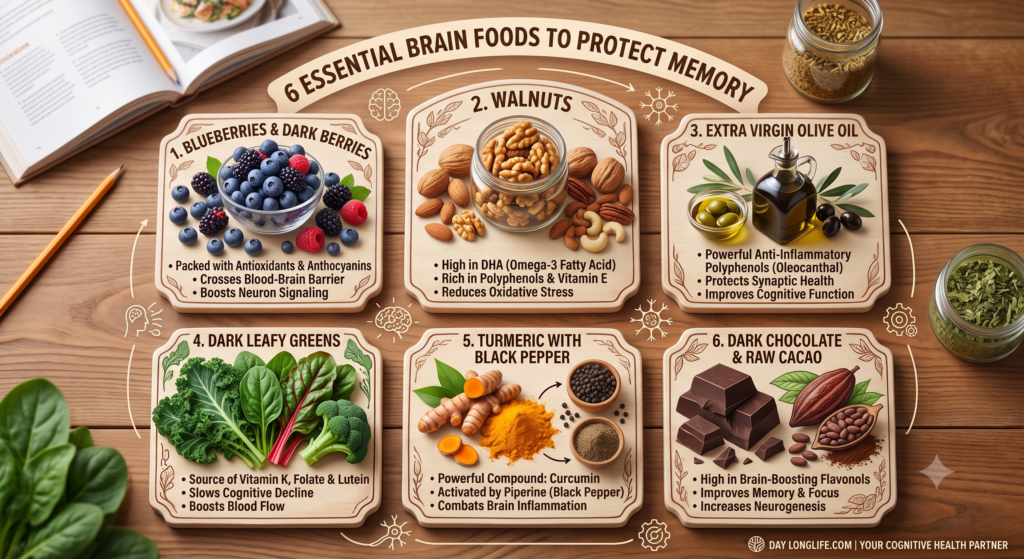
6 Powerful Brain Foods to Add to Your Pantry
You don’t need complex dietary supplements to nourish your nervous system. Nature has already packaged the essential compounds for brain longevity into vibrant, whole foods.
1. Blueberries & Dark Berries (The Antioxidant Powerhouses)
Berries are consistently ranked among the top foods for brain health, and for good reason.
- The Science: Dark berries are loaded with anthocyanins, a subclass of flavonoids with potent antioxidant and anti-inflammatory effects. These compounds cross the blood-brain barrier to neutralize free radicals and reduce neuroinflammation.
- The Benefit: Regular consumption of blueberries has been shown to improve communication between brain cells, increase brain plasticity, and delay age-related memory decline.
- How to Enjoy: Stir a handful of fresh or frozen blueberries into your morning warm oatmeal or enjoy them as a simple afternoon snack.
2. Walnuts (The Plant-Based Omega-3 Shield)
It is no coincidence that a walnut looks remarkably like a miniature human brain.
- The Science: Walnuts are exceptionally high in alpha-linolenic acid (ALA), a plant-based omega-3 fatty acid, along with polyphenols and vitamin E. Omega-3s are critical building blocks for brain cell membranes.
- The Benefit: They help lower blood pressure, protect arteries, and reduce oxidative stress in the brain, which supports faster information processing and improved memory retention.
- How to Enjoy: Sprinkle a small handful of toasted walnuts over roasted root vegetables or leafy green salads for a satisfying crunch.
3. Dark Leafy Greens (The Cognitive Preservers)
Leafy greens are dietary staples in every Blue Zone across the globe, acting as daily armor against cognitive aging.
- The Science: Spinach, kale, Swiss chard, and collard greens are rich in brain-protecting nutrients, including vitamin K, lutein, folate, and beta-carotene.
- The Benefit: Research indicates that individuals who consume just one serving of leafy greens per day experience a slower rate of cognitive decline—their brain scans resemble those of people up to 11 years younger!
- How to Enjoy: Gently braise greens in olive oil and garlic, or stir fresh kale into your favorite slow-simmered soups and stews.
4. Turmeric with Black Pepper (The Neuro-Inflammation Soother)
This golden spice is a celebrated staple in both Ayurvedic medicine and modern longevity science.
- The Science: Curcumin, the active compound in turmeric, has been shown to boost Brain-Derived Neurotrophic Factor (BDNF)—a vital growth hormone that functions like “fertilizer” for your brain cells, encouraging new neurons to grow and thrive.
- The Benefit: Curcumin helps clear protein plaques associated with age-related cognitive decline while soothing systemic inflammation.
- How to Enjoy: Always pair turmeric with a pinch of black pepper (which boosts curcumin absorption by 2,000%) and a healthy fat like extra virgin olive oil or coconut milk.
5. Extra Virgin Olive Oil (The Mediterranean Elixir)
Healthy dietary fats are essential for cognitive longevity, and cold-pressed extra virgin olive oil reigns supreme.
- The Science: Packed with monounsaturated fats and powerful polyphenols like oleocanthal, extra virgin olive oil protects the vascular system that feeds the brain.
- The Benefit: It promotes autophagy—the brain’s natural cellular cleanup process that breaks down and clears out damaged cell debris and toxins before they accumulate.
- How to Enjoy: Use it generously as a finishing oil, drizzling it raw over warm soups, roasted carrots, and fresh tomato salads just before serving.
6. Dark Chocolate & Raw Cacao (The Focus Enhancer)
Nourishing your brain should feel indulgent, and dark chocolate is proof that healthy eating can be deeply satisfying.
- The Science: High-percentage dark chocolate (70% cocoa or higher) and raw cacao are packed with brain-boosting flavanols, caffeine, and antioxidants.
- The Benefit: Cacao flavonoids gather in the areas of the brain responsible for learning and memory. They increase cerebral blood flow, enhance focus, and provide a gentle, sustained mood lift by stimulating endorphin and serotonin production.
- How to Enjoy: Savor one or two squares of 80% dark chocolate alongside your afternoon cup of herbal tea.
Building a Brain-Boosting Daily Plate
You don’t have to overhaul your entire diet overnight to see benefits in your mental clarity. Start by making simple, delicious swaps that build cumulative resilience over time:
- Swap your cooking oil: Reach for extra virgin olive oil instead of refined vegetable oils.
- Add color to your breakfast: Throw half a cup of dark berries onto your morning porridge or toast.
- Upgrade your snacks: Keep a jar of raw walnuts or almonds on your kitchen counter instead of processed crackers.
- Spice generously: Add a daily dash of golden turmeric and black pepper to your soups, roasted vegetables, and grains.
Nourishing an ageless mind begins in the kitchen. When you feed your body with real, antioxidant-rich, anti-inflammatory whole foods, you are actively investing in a clearer, sharper, and more vibrant future.
What is your favorite “brain food” to cook with at home? Have you ever noticed a shift in your mental clarity after eating a clean, nutrient-dense meal? Share your experience in the comments below!
-
The Ageless Mind: Harnessing the Power of Daily Affirmations for Cognitive Vitality
At DAYLONGLIFE, we often talk about how the food on our plates and the water in our mugs shape our health. But there is another vital input that influences your nervous system, stress levels, and brain longevity every single day: your inner dialogue.
An “ageless mind” isn’t just maintained through crosswords, nutritious meals, or proper sleep. It is actively shaped by the thoughts you repeat. In modern neuroscience, this concept is backed by neuroplasticity—the brain’s remarkable ability to reorganize itself, form new neural connections, and adapt throughout your entire life.
By practicing positive, intentional affirmations, you can rewire automatic thought patterns, calm chronic stress response, and cultivate mental sharpness and emotional resilience.
The Science: How Affirmations Protect Your Brain
When you experience stress, self-doubt, or anxiety about aging, your brain releases cortisol and adrenaline. Over time, chronic exposure to these stress hormones causes neuroinflammation and impairs memory processing in the hippocampus.
Positive affirmations act as a mental pause button:
- Interrupts Fight-or-Flight: Repeating calming, empowering phrases shifts your nervous system from sympathetic (stress) to parasympathetic (rest and repair) mode.
- Strengthens Neural Pathways: Just as physical exercise strengthens muscles, repeating constructive thoughts reinforces adaptive pathways in your prefrontal cortex—the center for decision-making, focus, and emotional regulation.
- Enhances Self-Efficacy: Research shows that self-affirmation activates the brain’s reward centers, making you more resilient to daily setbacks and more likely to maintain healthy lifestyle choices.
7 Affirmations for an Ageless Mind
To get the most out of affirmations, pair them with deep breathing or a quiet morning ritual (like sipping warm herbal tea or journaling). Repeat each statement slowly, allowing your mind and body to fully feel its truth.
1. On Cognitive Vitality
“My mind is clear, adaptable, and constantly expanding with wisdom and curiosity.”
2. On Stress Release & Calm
“I release what I cannot control and welcome peace into my nervous system.”
3. On Graceful Aging
“Every year adds depth, strength, and vitality to my mind and body.”
4. On Focus & Mental Clarity
“I nourish my brain with rest, presence, and calm intention.”
5. On Resilience & Health
“My body knows how to heal, balance, and thrive at every stage of life.”
6. On Mindfulness & Being Present
“I am grounded in this moment, free from the burdens of yesterday and tomorrow.”
7. On Gratitude & Vitality
“I am grateful for the vitality flowing through my mind, body, and spirit today.”
How to Integrate Affirmations into Your Daily Routine
- Morning Light Anchor: Speak 2 or 3 affirmations aloud while standing near a sunlit window or sipping your morning water.
- Post-Meditation / Breathwork: Repeat your chosen affirmation right after a 4-7-8 breathing session when your brain is in a receptive, calm state.
- Sticky Note Reminders: Write one statement on a card and place it on your desk, bathroom mirror, or kitchen counter as a gentle reminder throughout the afternoon.
Cultivating Mental Longevity Every Day
Your thoughts are the soundtrack to your life. Choosing self-compassion, clarity, and calm isn’t just positive thinking—it is active, loving care for your brain’s long-term vitality.
Which affirmation resonated with you most today? Do you have a personal daily mantra that keeps your mind clear and calm? Share it in the comments below!
-
The Ageless Mind: How Reducing Stress Protects Your Brain for Life
When we talk about longevity at DAYLONGLIFE, the conversation often turns to physical vitality—nourishing meals, gentle movement, and restorative sleep. But there is another crucial organ that dictates how gracefully we age: our brain.
An “ageless mind” isn’t about denying the passage of time or chasing impossible youth; it’s about preserving mental clarity, emotional resilience, sharp focus, and cognitive adaptability at every stage of life.
And the single biggest threat to that sharp, vibrant mind? Chronic stress.
The Hidden Cost of Chronic Stress on the Brain
Stress is a natural survival mechanism designed for short-burst emergencies. However, when daily pressures become a constant backdrop, the body’s elevated cortisol levels quietly impact long-term brain health:
- Shrinkage of the Memory Center: Prolonged high cortisol levels affect the hippocampus—the region of the brain responsible for memory consolidation, learning, and emotional regulation.
- Neuroinflammation: Persistent mental stress triggers subtle inflammatory responses in the brain, accelerating cognitive fatigue and brain fog.
- Impairs Neuroplasticity: Neuroplasticity is the brain’s remarkable ability to grow, adapt, and build new neural pathways. Chronic stress puts the brain into defense mode, making it harder to learn new skills or adapt to change.
In short, managing daily stress is not just a luxury for your mood—it is essential maintenance for your nervous system and brain vitality.
4 Mindful Practices to Protect Your Cognitive Health
To keep your mind sharp and adaptive, the goal isn’t to eliminate all stress, but to build a nervous system that resets quickly. Here are four daily rituals to cultivate mental longevity:
1. Daily Down-Regulation through Breathwork
When work or daily demands build up, your nervous system slips into “fight or flight.” Taking just 3 to 5 minutes to practice deep, rhythmic breathing signals immediate safety to your brain.
- Try the 4-7-8 Technique: Inhale quietly through your nose for 4 seconds, hold your breath gently for 7 seconds, and exhale slowly through your mouth for 8 seconds. This simple pattern stimulates the vagus nerve, lowering heart rate and clearing mental noise.
2. Sensory Grounding & Aromatherapy Rituals
Engaging your senses is one of the fastest ways to pull an overactive mind out of anxious loops and back into the present moment.
- Mindful Touch & Smell: Incorporating calming essential oil blends (like lavender, frankincense, or sandalwood) during a brief neck or temple massage can ease physical tension in your muscles while signaling your mind to pause and rest.
3. “Brain Food” & Herbal Support
What nourishes your body also directly influences brain chemistry. Incorporating rich antioxidants, healthy fats (like extra virgin olive oil and walnuts), and soothing herbal teas into your daily routine reduces systemic oxidative stress.
- Calming Teas: Sipping warm herbal infusions—such as chamomile, lemon balm, or gentle spice teas—provides an intentional micro-break in your day, encouraging calm, steady focus rather than jittery overstimulation.
4. Intentional Mental “Sabbaticals”
Continuous multitasking exhausts your brain’s executive function. Protect your mental energy by creating non-negotiable boundaries:
- Set aside 15 minutes of uninterrupted quiet time every afternoon without screens.
- Engage in a creative hobby—like cooking a new recipe or writing—where your brain can enter a relaxed, meditative “flow” state.
Cultivating Calm as a Daily Philosophy
An ageless mind is built through quiet, consistent care. By lowering the background noise of stress and offering your brain regular moments of peace, you protect your cognitive vitality for decades to come.