Cognitive Reserve: How Seeking Novelty Keeps Your Brain Decades Younger
At DAYLONGLIFE, we often focus on physical movement and diet for long-term health, but keeping an Ageless Mind requires its own dedicated training ground.
Many people assume that doing the same daily crossword puzzle or playing a familiar memory game is enough to protect cognitive health. However, modern neuroscience reveals a surprising truth: once your brain becomes efficient at a task, it operates on autopilot—demanding very little metabolic energy or synaptic remodeling.
To build true cognitive reserve—the brain’s ability to improvise, find alternate neural pathways, and resist age-related decline—you must intentionally expose your mind to novelty, complexity, and active skill acquisition.
The Neuroscience of Cognitive Reserve & Neurogenesis
Your brain contains roughly 86 billion neurons connected by trillions of synapses. Throughout your entire lifespan, your brain retains the capacity for neuroplasticity—the ability to form new neural connections and physically reorganize itself in response to learning:
- Synaptogenesis Through Challenge: When you tackle a completely unfamiliar skill (like learning a new language, picking up an instrument, or navigating a new city without GPS), your brain is forced to sprout new dendrites and forge fresh synaptic connections.
- Building the Neural Buffer: Cognitive reserve acts like a mental savings account. Individuals with high cognitive reserve can experience physical changes in brain structure with age without exhibiting memory loss or functional decline, because their brains seamlessly reroute information around damaged pathways.
- Dopamine & Motivation Loops: Novel experiences trigger the release of dopamine from the substantia nigra and ventral tegmental area. Dopamine not only enhances mood and motivation, but also acts as a biological bookmark—signaling to the hippocampus that a new memory or skill is valuable enough to consolidate.
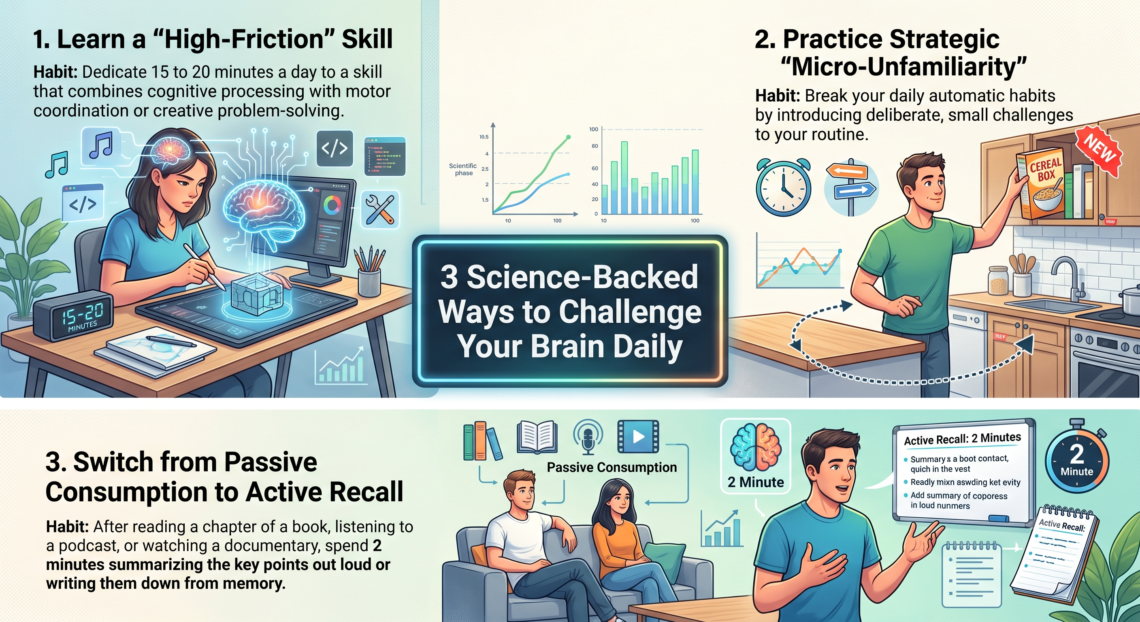
3 Science-Backed Ways to Challenge Your Brain Daily
To build cognitive reserve effectively, a task must meet two criteria: it must be novel (something you haven’t mastered) and mentally demanding (requiring focused concentration).
1. Learn a “High-Friction” Skill
- The Habit: Dedicate 15 to 20 minutes a day to a skill that combines cognitive processing with motor coordination or creative problem-solving.
- Examples: Playing the acoustic guitar or piano, learning conversational conversational phrases in a new language, taking up pottery, or learning chess opening strategies.
- Why it works: Complex skills engage multiple brain networks simultaneously—combining auditory, visual, motor, and executive functioning centers into a coordinated neural orchestra.
2. Practice Strategic “Micro-Unfamiliarity”
- The Habit: Break your daily automatic habits by introducing deliberate, small challenges to your routine.
- Examples: Brushing your teeth or eating with your non-dominant hand, taking a completely new walking route home without checking a map app, or learning to read music notation.
- Why it works: Forcing your brain out of automatic execution activates the prefrontal cortex, heightening alertness and stimulating spatial awareness.
3. Switch from Passive Consumption to Active Recall
- The Habit: After reading a chapter of a book, listening to a podcast, or watching a documentary, spend 2 minutes summarizing the key points out loud or writing them down from memory.
- Examples: Keeping a daily “learning journal” where you record three new facts or concepts you encountered during the day.
- Why it works: Passive consumption (scrolling videos or listening casually) builds very little cognitive reserve. Active retrieval forces your brain to reconstruct memory traces, strengthening neural wiring.
A Mind That Never Stops Growing
Brain aging is not an inevitable downhill slope—it is a malleable process heavily influenced by how you use your mind every day. By stepping out of comfortable mental routines and embracing the satisfying friction of learning something new, you ensure that your mind remains sharp, creative, and resilient for decades to come.

You May Also Like

The Ageless Mind: 5 Antioxidant-Rich Fruits That Protect Memory and Brain Power

The Ageless Mind: Harnessing the Power of Daily Affirmations for Cognitive Vitality