-
Protecting Your Vision: Micro-Habits for Eye Health in a Screen-Filled World
At DAYLONGLIFE, we often focus on heart, brain, and gut health, but your eyes are among the most energy-intensive, delicate organs in your body.
In our digital age, the average person spends over 6 to 8 hours a day staring at backlit screens. This constant near-focus demands immense work from delicate ciliary muscles, while blue light radiation and reduced blink rates cause eye strain, dryness, head tension, and accelerated macular fatigue.
Protecting your vision for the long haul doesn’t require drastic lifestyle overhauls—it comes down to simple, everyday habits that relax ocular muscles, lubricate tissues, and feed your retina essential nutrients.
The Biological Toll of Digital Eye Strain
When you look at a screen or smartphone, three distinct biological stress factors occur simultaneously:
- The “Blink Amnesia” Effect: Normally, we blink about 15 to 20 times per minute, sweeping a fresh layer of tear film over the cornea. When staring at screens, our blink rate drops by up to 50%, leading to rapid tear evaporation, chronic dry eye, and microscopic surface irritation.
- Ciliary Muscle Spasm: The tiny muscles inside your eye must contract continuously to keep close objects in sharp focus. Holding this contraction for hours without a break creates physical fatigue that manifests as tension behind the eyes and brow tightness.
- Retinal Oxidative Stress: The macula—the central area of your retina responsible for sharp, detailed vision—is constantly exposed to high-energy visible (HEV) blue light, which increases free radical damage over time if not counteracted by dietary antioxidants.
4 Everyday Practices for Lifelong Eye Vitality
Integrating these evidence-backed micro-habits into your work routine will instantly reduce fatigue and protect long-term visual acuity.
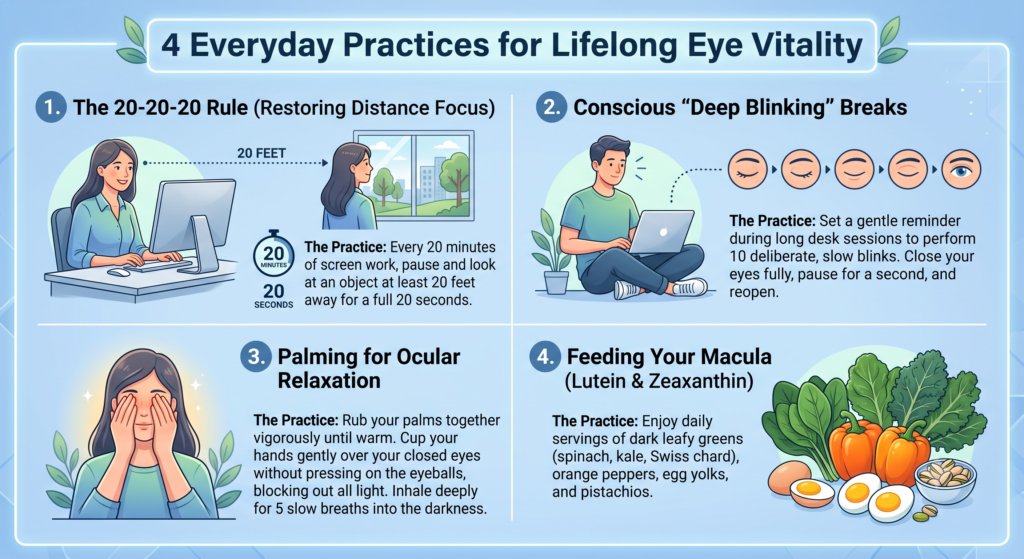
1. The 20-20-20 Rule (Restoring Distance Focus)
- The Practice: Every 20 minutes of screen work, pause and look at an object at least 20 feet away for a full 20 seconds.
- Why it works: Looking into the distance completely relaxes the ciliary muscle inside your eye, breaking the cycle of constant close-focus strain and resetting ocular blood flow.
2. Conscious “Deep Blinking” Breaks
- The Practice: Set a gentle reminder during long desk sessions to perform 10 deliberate, slow blinks. Close your eyes fully, pause for a second, and reopen.
- Why it works: Complete blinks squeeze the meibomian glands along your eyelids, releasing crucial lipid oils that seal in moisture and prevent tears from evaporating rapidly.
3. Palming for Ocular Relaxation
- The Practice: Rub your palms together vigorously until warm. Cup your hands gently over your closed eyes without pressing on the eyeballs, blocking out all light. Inhale deeply for 5 slow breaths into the darkness.
- Why it works: The soothing warmth releases muscle tension around the eye sockets, while complete darkness calms the optic nerve and nervous system.
4. Feeding Your Macula (Lutein & Zeaxanthin)
- The Practice: Enjoy daily servings of dark leafy greens (spinach, kale, Swiss chard), orange peppers, egg yolks, and pistachios.
- Why it works: These foods are rich in lutein and zeaxanthin, fat-soluble carotenoids that act as internal sunglasses. They accumulate directly in the macula, filtering blue light and neutralizing free radicals.
A Quick Daily Ritual for Fresh Eyes
Next time you finish a long stretch of work, don’t immediately reach for your phone to scroll during your break. Step to a window, gaze out at the distant horizon, take three deep breaths, and let your eyes rest in natural light. Your visual health will thank you for years to come.
-
Emerald Armor: The Anti-Inflammatory Science & Simple Preparation of Spinach
At DAYLONGLIFE, we consider dark leafy greens to be the undisputed foundation of Blue Zone cooking. Among these greens, spinach stands out as a versatile, nutrient-dense power vegetable that seamlessly bridges the gap between The Longevity Kitchen and the Ageless Mind.
While raw spinach is a popular base for summer salads, gentle cooking turns this humble green into an anti-inflammatory powerhouse—softening its fibers, boosting nutrient availability, and making it exceptionally kind to your digestive system (Agni).
Today, we are showcasing spinach with a classic, warm Mediterranean recipe: Gently Braised Garlic & Olive Oil Spinach with Lemon and Toasted Pine Nuts.
Why Spinach is a Longevity & Brain Superfood
Spinach is packed with vital micronutrients, nitrates, and carotenoids that shield your cardiovascular system and preserve cognitive sharpness:
- Brain Preserving (Lutein & Folate): Spinach is exceptionally high in lutein and zeaxanthin, fat-soluble carotenoids that accumulate directly in brain tissue. Studies show that daily consumption of dark leafy greens like spinach can help keep your brain functioning like that of someone up to 11 years younger!
- Vascular Health & Nitrates: Naturally rich in dietary nitrates, spinach stimulates nitric oxide production in blood vessels, relaxing arterial walls, lowering blood pressure, and boosting circulation to the brain and heart.
- Bone & Blood Support (Vitamin K & Iron): A single serving delivers over 100% of your daily Vitamin K needs to support bone density and arterial health, alongside non-heme iron for cellular oxygenation.
Raw vs. Cooked Spinach: Unlocking Maximum Bioavailability
Many people eat spinach raw, but gently cooking spinach offers distinct longevity benefits:
- Reduces Oxalates: Raw spinach contains naturally occurring oxalates, which can bind to minerals like calcium and iron, making them harder to absorb. Lightly steaming or braising spinach breaks down oxalates, unlocking its rich mineral profile.
- Softens Insoluble Fiber: Cooked greens are significantly easier to digest, preventing the bloating or gas that raw cruciferous and leafy greens can sometimes cause.
- Enhances Carotenoid Absorption: Heat breaks down the tough plant cell walls, freeing up lutein and beta-carotene so your body can absorb them easily—especially when paired with a healthy fat like extra virgin olive oil.
Simple Recipe: Gently Braised Garlic & Olive Oil Spinach
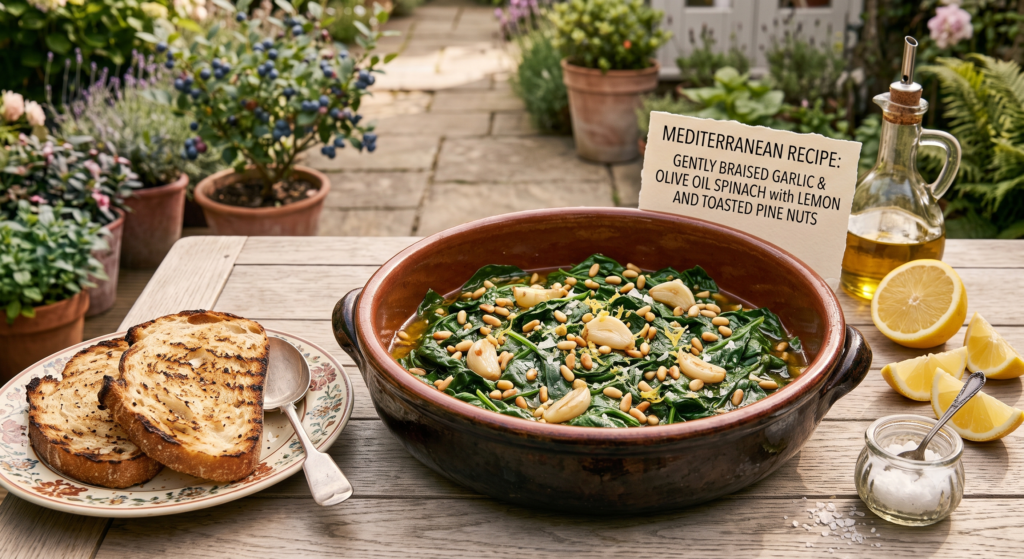
This 10-minute side dish is simple, comforting, and packed with anti-inflammatory synergy.
🌿 Ingredients (Serves 2–3)
- 1 lb (450g) Fresh organic baby spinach (washed and thoroughly dried)
- 2 tbsp High-quality cold-pressed extra virgin olive oil
- 3 cloves Garlic, thinly sliced
- 1 tbsp Fresh lemon juice (plus a pinch of fresh lemon zest)
- 2 tbsp Raw pine nuts or sliced almonds
- Sea salt and freshly cracked black pepper to taste
🥣 Step-by-Step Instructions
- Toast the Nuts: In a wide skillet or pan, toast the pine nuts over medium-low heat for 2 to 3 minutes until lightly golden and fragrant. Transfer them to a small bowl and set aside.
- Warm the Olive Oil & Garlic: In the same skillet, warm the extra virgin olive oil over medium-low heat. Add the sliced garlic and sauté gently for 1 minute until soft and aromatic—be careful not to brown or burn the garlic!
- Wilt the Spinach: Add the fresh baby spinach to the skillet in large handfuls. Using tongs, gently toss the spinach in the warm garlic oil. Cover with a lid for 60 to 90 seconds until the leaves just collapse into a bright, emerald-green texture.
- Finish & Serve: Remove from heat immediately. Drizzle with fresh lemon juice, season with sea salt and cracked black pepper, and toss to combine. Transfer to a warm serving bowl, sprinkle with the toasted pine nuts, and grate a touch of lemon zest over top.
Longevity Tip: The Vitamin C & Iron Connection
The iron found in plant foods (non-heme iron) is best absorbed when paired with Vitamin C. Finishing warm braised spinach with a fresh squeeze of lemon juice not only brightens the earthy flavor but also doubles your body’s ability to absorb its essential iron!