Protecting Your Vision: Micro-Habits for Eye Health in a Screen-Filled World
At DAYLONGLIFE, we often focus on heart, brain, and gut health, but your eyes are among the most energy-intensive, delicate organs in your body.
In our digital age, the average person spends over 6 to 8 hours a day staring at backlit screens. This constant near-focus demands immense work from delicate ciliary muscles, while blue light radiation and reduced blink rates cause eye strain, dryness, head tension, and accelerated macular fatigue.
Protecting your vision for the long haul doesn’t require drastic lifestyle overhauls—it comes down to simple, everyday habits that relax ocular muscles, lubricate tissues, and feed your retina essential nutrients.
The Biological Toll of Digital Eye Strain
When you look at a screen or smartphone, three distinct biological stress factors occur simultaneously:
- The “Blink Amnesia” Effect: Normally, we blink about 15 to 20 times per minute, sweeping a fresh layer of tear film over the cornea. When staring at screens, our blink rate drops by up to 50%, leading to rapid tear evaporation, chronic dry eye, and microscopic surface irritation.
- Ciliary Muscle Spasm: The tiny muscles inside your eye must contract continuously to keep close objects in sharp focus. Holding this contraction for hours without a break creates physical fatigue that manifests as tension behind the eyes and brow tightness.
- Retinal Oxidative Stress: The macula—the central area of your retina responsible for sharp, detailed vision—is constantly exposed to high-energy visible (HEV) blue light, which increases free radical damage over time if not counteracted by dietary antioxidants.
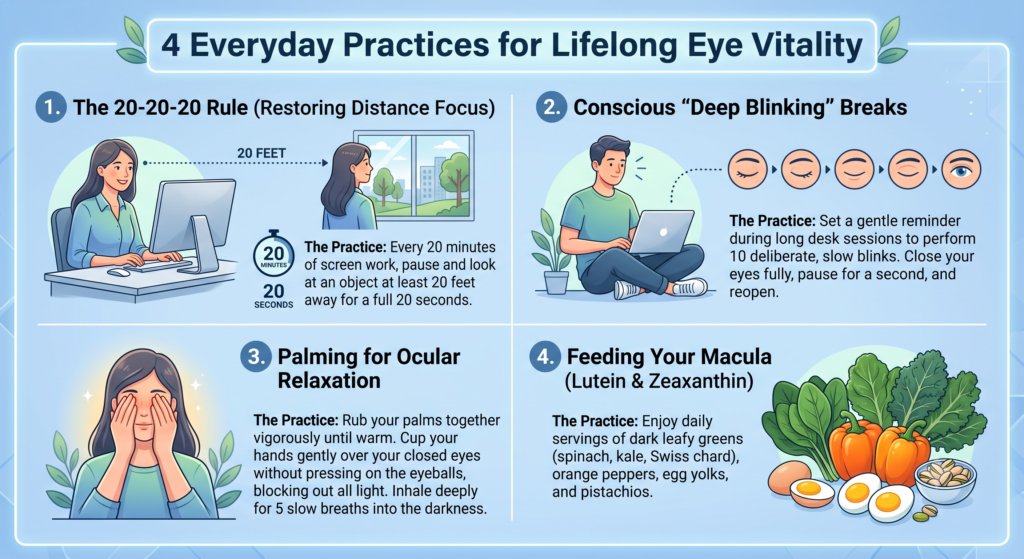
4 Everyday Practices for Lifelong Eye Vitality
Integrating these evidence-backed micro-habits into your work routine will instantly reduce fatigue and protect long-term visual acuity.
1. The 20-20-20 Rule (Restoring Distance Focus)
- The Practice: Every 20 minutes of screen work, pause and look at an object at least 20 feet away for a full 20 seconds.
- Why it works: Looking into the distance completely relaxes the ciliary muscle inside your eye, breaking the cycle of constant close-focus strain and resetting ocular blood flow.
2. Conscious “Deep Blinking” Breaks
- The Practice: Set a gentle reminder during long desk sessions to perform 10 deliberate, slow blinks. Close your eyes fully, pause for a second, and reopen.
- Why it works: Complete blinks squeeze the meibomian glands along your eyelids, releasing crucial lipid oils that seal in moisture and prevent tears from evaporating rapidly.
3. Palming for Ocular Relaxation
- The Practice: Rub your palms together vigorously until warm. Cup your hands gently over your closed eyes without pressing on the eyeballs, blocking out all light. Inhale deeply for 5 slow breaths into the darkness.
- Why it works: The soothing warmth releases muscle tension around the eye sockets, while complete darkness calms the optic nerve and nervous system.
4. Feeding Your Macula (Lutein & Zeaxanthin)
- The Practice: Enjoy daily servings of dark leafy greens (spinach, kale, Swiss chard), orange peppers, egg yolks, and pistachios.
- Why it works: These foods are rich in lutein and zeaxanthin, fat-soluble carotenoids that act as internal sunglasses. They accumulate directly in the macula, filtering blue light and neutralizing free radicals.
A Quick Daily Ritual for Fresh Eyes
Next time you finish a long stretch of work, don’t immediately reach for your phone to scroll during your break. Step to a window, gaze out at the distant horizon, take three deep breaths, and let your eyes rest in natural light. Your visual health will thank you for years to come.


You May Also Like

Solar Vitality: The Science & Ritual of Mindful Sunbathing for Longevity

Hydration for Longevity: How Mindful Water Drinking Transforms Your Everyday Wellness